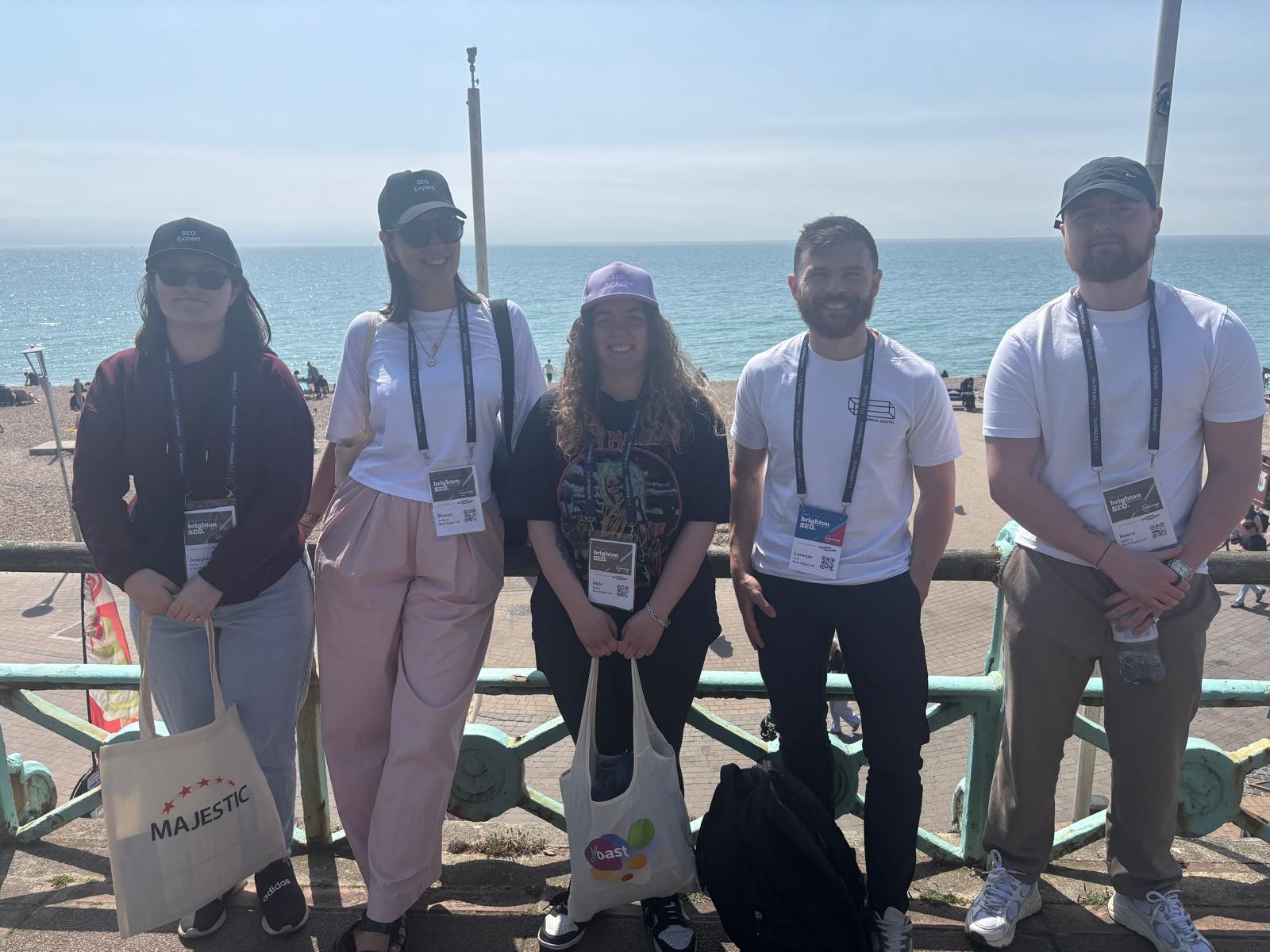
brightonSEO is one of those events that reminds you why you chose to work in SEO. Twice a year, the industry descends on the south coast for two days of talks, debates, and the kind of blue-sky thinking that doesn’t always happen in the office. This time around, Brick were there as sponsors, with a team split between seasoned brightonSEO “veterans” and a handful of staff members experiencing it for the very first time.
With so much change happening in the industry, there was a lot of ground to cover in only two days of conference time. Luckily, our “divide and conquer” strategy led to some key learnings, which this blog post will explore.
Unsurprisingly, AI Search was the hottest topic
If there was a single thread running through this year’s conference, it was this: the rules of search are being rewritten, and the brands that take the time to understand what AI systems really need from them will be the ones that come out ahead in the new platform of AI search.
We’re done debating whether AI search is going to take off or not – we know that it’s here, and we know that it’s an important part of modern and future SEO practices. Instead, the question everyone was working through was: what do we actually do about it?
Brand Is Now Table Stakes
As the saying goes, “all roads lead to Rome”. In the case of brightonSEO, multiple talks boiled down to the same point: brand has become a foundational SEO signal, and that’s just as true for AI systems deciding what to surface as it is for Google.
Abbi Russell, one of Brick’s Senior SEO Executives, attended several talks that leaned into this idea.
“One key question that stood out to me was, if your website disappeared tomorrow, would your brand still appear in Google? This comes down to brand authority – backlinks from reputable external sources, reviews, and your wider presence on the web. These are all existing elements of good SEO practice, but it was an interesting thing to consider. If no one can find you online apart from your website, why would Google or AI trust you as a recommended source?”
Good conference speakers love a headline statistic, and Abbi highlighted one such statistic that was delivered in a talk: 56% of AI mentions come from external sources: reviews, listicles, guides, and other websites in your niche. Backlinks have always been important in SEO, but the reason for that importance has shifted. Raw SEO value still counts, but what AI systems are really reading is the trust signal – does the wider web vouch for you?
Senior SEO Executive Reece Osbourne, who was attending brightonSEO for the second time, puts this in plain terms: “Brand is everything. Understand the sentiment around your brand, and audit it using AI. What do various AI search platforms think of you? Reviews, mentions – these are the cues AI will take from when it speaks about you.”
In practice, that means prioritising branded anchor links over keyword-anchored ones, and making brand sentiment checks a routine part of SEO workflow – literally asking AI tools how they view your brand, and what you can do to “edit” its perception of you.
Having a Website Isn’t Enough
Brick founder and CEO, Lorenzo Luiso, has been to Brighton a few times now, and his experience zeroed in on something that’s often missed in the AI search conversation: AI systems don’t just evaluate websites, they evaluate entities. While it’s a good start, a well-optimised site doesn’t fully answer the “question” AI is asking when it reviews your site.
As Lorenzo put it: “The question being asked is no longer ‘does this domain have authority’ but ‘do we know enough about this business to trust it?’ For most SMEs, the infrastructure that answers that question consists of consistent brand descriptors, knowledge graph presence, structured data, and Wikidata listings – and most simply don’t have it yet. Building it is one of the most underleveraged opportunities in SEO right now.”
SEO Executive Jo Harvey picked up on something similar from one of the talks, which laid out three things every brand should audit: whether key pages are crawlable by AI bots, what people and LLMs are actually saying about you, and what you’re saying about yourself. The technical fix runs across semantic, trust and authority, and structured data layers – with schema markup called out specifically as a straightforward route to getting cited by AI that most sites aren’t making the most of.
If AI Can Write Your Content, You Need Better Content
The question hanging over the content discussions was a simple one: if AI can generate a version of your article in seconds, what’s the point of yours?
Lorenzo’s view: “The content question has shifted from ‘how do we rank’ to ‘how do we say something no one else can.’ AI-generated content is flooding every category, and the agencies and businesses that win will be the ones that systematically extract genuine expertise through client interviews, proprietary data, and lived experience – and turn that into content that can’t be replicated.”
Reece built on this through the lens of EEAT. AI-assisted content isn’t automatically a problem, but it needs to be anchored in real expertise: author bios linked to credible profiles, editorial guidelines, content that’s been properly checked and reviewed. Structure is an important aspect as well – adding TLDRs (“Too long, didn’t read”) and jump links at the top of articles is more than just a thoughtful slice of UX design – it’s also how AI systems parse and pull from your content.
GEO Encompasses Multiple Strategies
Lorenzo also flagged something that will become increasingly important as AI search matures: different AI tools pull from different sources, meaning a single GEO approach won’t cover you for long. As the landscape develops, businesses will need to get more clued up on which AI tools their customers use, and adjust accordingly.
On the tactical side, Reece’s takeaways from the conference highlight GEO listicles as a priority, using Reddit and social media to feed genuinely useful content ideas rather than just search-optimised ones, and digging into contact form submissions to surface the actual language customers use (rather than “industry insider” terminology, which some businesses try to target).
That last one might sound unglamorous, but it’s precisely the kind of signal that AI systems respond to, and most brands are sitting on the data without realising its value.
Fresh Perspectives From A First-Timer
For the team members attending Brighton for the first time, the experience itself was worth writing about.
SEO Executive Bianca De Toledo returned from the conference positively buzzing: “I was thrilled to be immersed in a room full of people that, much like myself and my team, live and breathe SEO every day – all equally curious about what the leading minds in our industry had to share.”
One talk that resonated with her gave an energising overview of the current landscape, making the case that traffic is now spread across far more channels than Google alone, and that strategies need to catch up. Another made a compelling argument for a single point of reference that helps PMs, SEO execs, and developers actually talk to each other, rather than past each other.
“Conversations in the talks and on the stands carried a consistent message: AI is here, and the future is full of opportunity,” Bianca said. “I came back with fresh ideas to bring to my clients’ roadmaps and a readiness to adapt as the landscape continues to grow.”
A Small Spotlight For Digital PR
Despite the name, SEO isn’t the only topic of discussion at brightonSEO, and having attended the conference numerous times across his career, Luke Milne, Brick’s Digital PR Executive, knows that each year hosts some fantastic talks around PR.
The talks he attended made a clear case for rethinking how digital PR earns its place in an AI-first search spectrum. One insight that stood out for him is that niche-relevant coverage is cited in AI more often than mass-media links. This is a useful counterweight to the assumption that a mention in a national publication automatically carries more weight – while these links still hold exceptional value in a traditional PR sense, when it comes to AI, relevance to your sector is more impactful than pure reach.
On the content side, one talk highlighted the importance of treating the headline of a PR campaign as the product itself – further evidence that editors are seeking punchy, “click-bait” headlines that will grab reader attention.
One key takeaway for Luke lay in how campaigns are positioned. Rather than running isolated campaigns, the case was made for working in content “ecosystems” – building a body of work around a theme over time, rather than chasing individual wins.
For brand authority specifically, the advice was similarly grounded: build a distinct founder story, use real photography, and keep messaging consistent across every platform. AI rewards repetition of clear, unique signals – and that’s as true for PR as it is for SEO.
What Comes Next
brightonSEO always sends us home with a healthy to-do list, and this year was no different. The through-line across almost everything we heard was the same: AI systems are making judgements about your brand based on what the wider web says about you, not just what your website says about itself. That means brand audits, schema markup, genuine expertise in content, and a backlink strategy built around trust rather than volume are no longer optional extras – they’re the work that requires the most focus for effective AI SEO.
For us here at Brick, we found reassurance in hearing many of our ideas and values in SEO mirrored by speakers and attendees alike, but also gained a wealth of new, actionable insights that we will soon be implementing into our daily practices. As always, we look forward to our next venture down to the coast for next year’s conference!